Happening Now
What We Lose If Long-Distance Traincars Mimic Corridor Cars
April 26, 2026
by Jim Mathews / President & CEO
Whenever we talk about long-distance trains there’s a temptation to slip into nostalgia, to talk about streamliners, and white tablecloths, and a lost golden age of travel that isn’t coming back.
Some people get mad at me when I say this, but I don’t find that argument very persuasive. Moreover, I don’t think many members of Congress who write the checks to buy new equipment do either, nor do the Federal policymakers who guide that process. But what does resonate, I think, is something much more immediate and much more contemporary: the growing scarcity of shared public space in American life, and the recognition, especially among younger Americans, that something important has been lost along the way.
It’s one of my strongest takeaways from our Washington, DC, week of advocacy this past week, when our volunteer Council of Representatives took a break midweek from visiting congressional offices to get a briefing from a bevy of Amtrak executives and managers working on the project to replace the bi-level Superliner long-distance railcar fleet.
The Q&A about that project quickly became a wish-list session, and if I had to summarize the biggest wishes they boiled down to seats, meals, and some kind of dome car. More on that below. But here’s the thing: don’t call that a retreat into nostalgia, because while it could be it’s really not. It’s actually a pretty simple and obvious plea: The Superliner replacement should preserve the train as a place people live for two days, not just a vehicle they occupy for two days.
When I started musing to myself about this, I kept thinking about the remarkable documentary "In Transit" filmed aboard the Empire Builder a shade more than ten years ago. It follows a cross-section of passengers over the course of a two-day journey, and what emerges is not just a travelogue but a kind of moving community. Strangers sit down together and talk. They share life stories. They offer advice, sometimes gently, sometimes bluntly. They listen. There is, at times, something that looks very much like informal therapy taking place across generational lines. And then, as the train reaches its destinations, that community dissolves as effortlessly as it formed.
What struck me watching it again recently is not how unusual this is, but how rare it has become elsewhere.
In most of American life today, we choose who we interact with, when we interact, and how much of ourselves we reveal. Our phones curate our conversations. Our workplaces, increasingly, allow us to avoid one another altogether. Even travel, especially air travel, has become an exercise in minimizing human contact. You move from curb to gate to seat to destination with as little friction, and as little interaction, as possible. For some of us, we have had to adjust, gradually, to that kind of world. For Generation Alpha, a personally curated world, mediated through screens and algorithmic choices, is all they’ve ever known.
And yet, when I talk to younger people — my own summer interns last year, among them — I hear something that cuts against that trend. They insisted on working in person. They wanted to be in an office. They wanted to observe, to listen, to be around other people figuring things out in real time. In other words, they were asking for proximity, for shared context, for the kinds of unplanned interactions that you can’t schedule into a Zoom call.
That’s exactly what long-distance trains still provide, if we let them.
When our members or supporters talk to us about replacing the aging Superliner fleet, they tend to focus on three things: seat comfort, real food, and access to a true observation space. It would be easy to dismiss these as mere creature comforts or as the preferences of a particularly vocal and superannuated subset of rail enthusiasts. But I don’t think that’s what they are. I think they are, collectively, a description of what it means to inhabit a space for two days rather than simply pass through it.
A couple of months ago I cautioned that Amtrak has to buy cars from the manufacturing base we have, not the one we wish we had, and must buy them in a timeframe that lets them enter service before my grandchildren marry and at a price that doesn't become congressionally unsupportable. I stand by that view. Our aspirations need to be shaped by realistic expectations. But at the same time, Amtrak has told me they're going to try to incorporate as many leading-edge amenities as possible in the new single-level environment. And if that's the case, we need to keep thinking about this idea that long-distance train riders inhabit their space for much longer than most any other travel mode, and design around it.
Seats on a long-distance train aren’t just seats; they're where people read, rest, think, sometimes sleep, and sometimes recover from a difficult day. Dining cars aren’t just places to eat; they’re one of the last remaining settings in American travel where strangers are intentionally seated together and expected to share a table. Observation cars aren’t just amenities; they’re the one place on the train where everyone, regardless of ticket class, can sit together and experience the country passing by at a human scale.
Take away those elements, and you don’t just simplify the train or make the production process more affordable. You change what a train actually is.
In my view, that translates into three design “guardrails.” The first I’ll call “endurance seating”; that is, coach seats must remain overnight capable by design. The next I’d put under the category of “institutional dining.” Food-preparation cars must support real kitchen operations, even if service models euphemistically “evolve.” If we don’t build kitchens, we’ll never expand what Amtrak now calls Traditional Dining. And the third guardrail is shared panoramic space. At least one car per consist must function as a universal observation commons.
There has been some suggestion that features like a dome or elevated observation space are relics of another era, or that modern accessibility requirements make them impractical. But I reject that idea. Engineers are clever by nature, and the Americans with Disabilities Act is a civil rights law, not a design veto. It challenges us to create spaces that are both accessible and meaningful, not to retreat into the lowest common denominator of what is easiest to build. If anything, a publicly supported service like Amtrak has an obligation to lead on that front.
A dome car isn’t a luxury add-on. It’s the one environment on the train where every passenger can experience the American landscape at continental scale. Instead of recreating a 1955 Vista-Dome, imagine specifying some kind of ramp-accessible elevated seating platform, panoramic glazing extending into roofline, rotating or semi-swivel seating clusters, integrated interpretive lighting or landscape overlays, mixed-duration seating (short stay plus long stay), and accessible companion seating at all elevations?
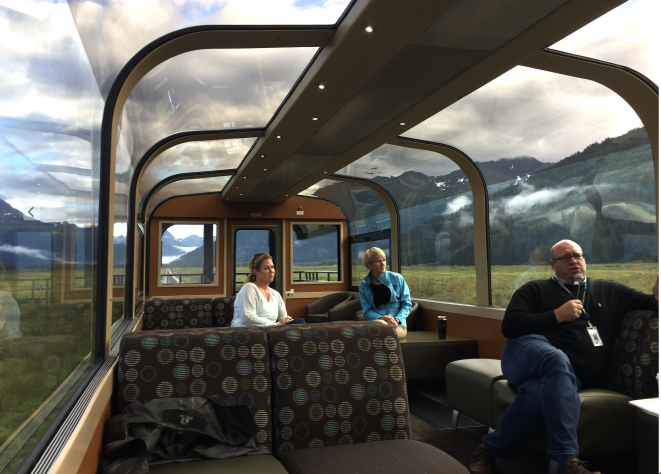
Even excellent glass-sided lounge cars (here I'm thinking about the beautiful Alaska Railroad Gold Star service cars) still anchor the passenger at window height. On the other hand, domes change three things simultaneously. Domes change sightlines, so that passengers see over vegetation, fences, berms, and freight consists. Domes change orientation, so passengers perceive the curvature of terrain and sky continuity. And domes mean shared attention. Everyone faces outward and upward together, which subtly encourages conversation in a way traditional forward-facing window seating does not.
The same is true when it comes to how we think about class and access. Increasingly, air travel is moving toward sharper separation between passengers based on what they can afford. In fact, last year Delta Air Lines’ President Glen Hauenstein made it clear in a finance call with Wall Street analysts that they’re only investing in passengers in the top 10-percent earnings bracket, since they’re accounting for close to half of America’s consumer spending. Premium cabins expand. Shared spaces shrink. Amenities migrate upward. The message becomes unmistakable: if you want dignity, pay more for it. And if you can't afford dignity? Go somewhere else.
Passenger rail doesn’t have to follow that model. In fact, it shouldn’t.
One of the enduring strengths of long-distance trains has always been that, at least in certain spaces like the lounge or the dining car, the boundaries between classes soften. People share space. They share views. They share conversations. It’s a kind of public value, a place where we can build (or, I suppose, rebuild) that sense of community that we’ve lost over the past decade or two.
As Amtrak and its Federal partners make decisions that will shape the next generation of long-distance equipment, we have a chance to be very clear about what these trains are for. Because Amtrak is supported by taxpayers, it carries a different responsibility. It can choose to design trains where coach passengers and sleeper passengers still share common territory. Where the best views aren’t restricted to the highest fare class. Where the dining car remains a democratic institution rather than a premium add-on. Where travelers encounter one another as fellow citizens rather than as customers sorted by price tier.
Even when most passengers aren’t traveling end-to-end (and we know that generally speaking only about 10 percent actually do that), they’re still entering an environment designed for end-to-end travel. That environment should feel different from corridor service in deliberate ways. It should support rest. It should support conversation. It should support shared experience of the American landscape at continental scale.
If we design these trains carefully, they can become something increasingly rare in modern life: places where people spend time together without having planned to do so in advance. And if the youngest generation entering public life is already telling us they’re looking for exactly that kind of environment, we should listen.
"The Rail Passenger Association's recognition of the essential work done by SMART-TD members aboard Amtrak during this difficult period is appreciated. The Golden Spike Award serves as a testament to the compassion and dedication our conductors, assistant conductors and other workers exhibit constantly through times both ordinary and extraordinary."
Jeremy Ferguson, SMART-TD President
December 21, 2021, on the Association awarding its 2021 Golden Spike Award to the Frontline Amtrak Employees.
Comments